Shopify Blog SEO Guide: Route Posts to Collection Pages
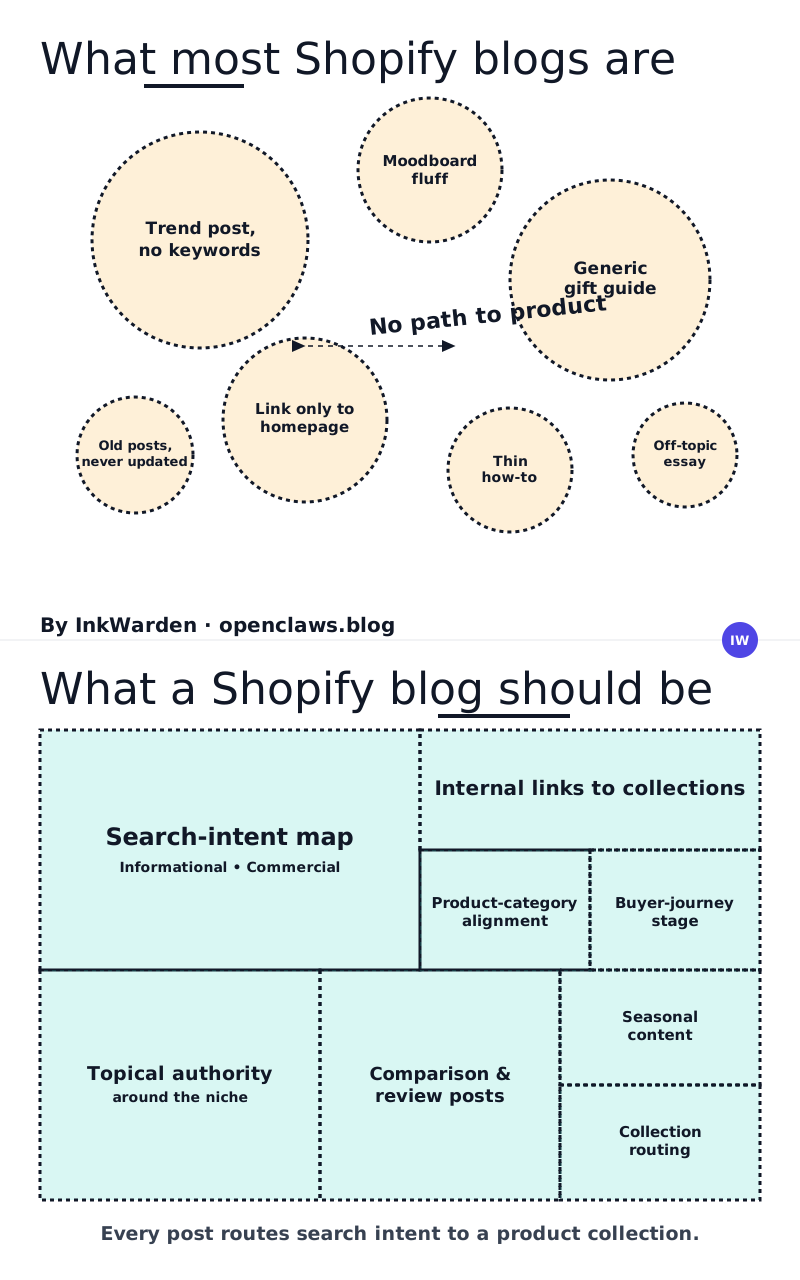
Are your posts pulling traffic but sending almost nobody to a product collection? Shopify blog SEO is the practice of using blog posts to answer search questions and route readers to the most relevant collection pages. In other words, it connects search engine optimization (SEO) visibility to a clear shopping next step. I believe most teams do not have a writing problem, they have a pathway design problem, and that is why traffic rises while sales intent stalls.[1][4]
Key Takeaways
- Shopify blog SEO works best when each post has one primary collection destination that matches intent.
- Contextual internal links move readers from informational searches to commercial pages with less friction.[3]
- Niche collections usually beat broad category links because they fit the exact question the reader asked.[10]
Say you run a beauty store and publish 4 posts this month. If all 4 end with no next click, you created content, not movement.
Why Shopify Blog SEO Stalls Without Pathways
Most teams treat blogging as a traffic channel only. That sounds logical, but it breaks your buyer journey in practice. Shopify itself frames blogs as part of your ranking and discovery engine, not a separate content island.[1][2]
Here is the thing: traffic without routing is a leak. Search Engine Land separates internal linking into two jobs: navigation links and contextual links. You need both. Navigation helps structure. Contextual links help decisions.[4]
In plain English: if a shopper reads your guide, gets their answer, and sees no relevant collection link, your SEO work ends at the question stage. A two-person ecommerce team that publishes weekly can lose ready-to-browse sessions each month this way.
I think this is the quiet reason many "successful" content calendars still underperform revenue goals. You are aiming for impressions, not next clicks.
The One Problem: Posts Answer Questions but Do Not Route Shoppers
Intent mismatch
Your reader arrives with an informational query. Your business needs a commercial next step. When that bridge is missing, the session dies. Practical Ecommerce has repeated this point for years: internal links affect crawl paths and discoverability, but they also shape user flow across your store.[5]
Imagine a solo Shopify operator publishing a post on "face oil vs moisturizer." After a few weeks, that post may attract visits but almost no collection clicks because the only link points to the homepage.
That is not a writing failure. It is a pathway failure. I would not fix this by adding more top-of-funnel posts. I would fix it by assigning a destination that matches buying intent.
Link mismatch
Even when links exist, they are often too broad. "Shop now" links to a generic catalog do not help users choose. Ahrefs and Moz both stress that internal links signal page relevance and priority, so vague anchors and vague destinations weaken the signal.[7][9]
Worth knowing: a fashion team can publish 6 outfit posts in 6 weeks and still fail to grow collection visibility if every post links to "Dresses" instead of "Wedding Guest Dresses" or "Linen Dresses for Summer."
The real problem is not that your blog is small. The real problem is that your internal links are non-committal.
The One Shopify SEO Solution: Build Post-to-Collection Pathways
If you want a shopify seo blog strategy that supports revenue, give each post one primary collection destination before you draft the outline. Semrush and Shopify both support this architecture thinking: plan links with intent, not as a final editing task.[8][3]
Pathway map template
Use this simple map: query intent → blog angle → destination collection. This answers the common question, how to link shopify blog posts to collection pages, in a repeatable way.
- Query: "how to style a neutral living room"
- Blog angle: styling sequence for texture and warmth
- Destination: Neutral Throw Pillows collection
Say a small home decor brand plans 8 posts for the next 60 days. If all 8 have a mapped destination before writing starts, you remove most dead-end risk upfront.
Contextual links and next-browse blocks
Add a small set of contextual links in-body where the reader naturally wants options. Then add one "Continue shopping this topic" block near the end. This creates your shopify blog internal linking strategy in two layers.
I think most brands underuse the end-of-post block. Do not skip it. A reader who made it to paragraph 12 is giving you high attention. Give them one clear next click.
Put differently, a pathway is not one random link. It is a planned route with specific anchor text and a specific landing page.
Need a related audit flow first? Start with Shopify SEO Checklist: 17 Fixes That Build an Owned Channel, then pair it with On Page SEO Checklist Weekly Workflow for Lean Teams.
Should You Prioritize Pathway Linking Right Now?
Prioritize this first when your posts already get impressions, readers bounce after reading, and collection pages need more relevant internal links. Defer it briefly only if your store still has unresolved crawl or indexing issues that block basic visibility.
Shopify Blog SEO Checklist for Post-to-Collection Linking
- Pick one primary collection destination before drafting the post.
- Use contextual anchors that match the shopper's exact question.
- Add one end-of-post next-browse block with primary and secondary options.
- Check that every link lands on a specific collection page, not the homepage.
- Review post-to-collection click-through in your 30-day check.
Collection Page SEO Comparison
If you are deciding where to spend the next 30 days, this is the tradeoff. A two-person ecommerce team publishing one post per week can use this table to choose the most effective model.
| Publishing model | Crawl clarity | User next step | Revenue assist potential | Example rollout speed |
|---|---|---|---|---|
| Dead-end post (no commercial links) | Low. Isolated URL with weak internal context. | Reader exits or returns to search. | Low | 0 planned pathway links |
| Homepage-linked post only | Medium. Link exists but destination is broad. | High friction. Reader must re-navigate. | Low to medium | 1 broad link (homepage) |
| Pathway-linked post (niche collection destination) | High. Clear relevance chain for crawlers. | Low friction. One obvious next click. | High | 1 mapped collection link |
| Pathway post + end-of-post next-browse block | High. Reinforced internal structure. | Very low friction. Decision support stays in flow. | Very high | 1 mapped link + 1 next-browse block |
| Pathway cluster (4 to 8 related posts) | Very high. Strong topical and commercial signals. | Multiple guided entry points by intent. | Highest over time | Cluster of 4 to 8 connected posts |
Shopify and ecommerce SEO guidance consistently rewards clearer site architecture, which is exactly what pathway linking creates.[2][6]
Getting Started: 5 Steps You Can Run This Week
- Audit your last 10 posts. Mark any post with no collection destination. A solo founder can do this in 45 minutes on Friday afternoon.
- Assign one primary collection per post by intent. Match informational question to the most specific commercial page.
- Add contextual links with precise anchors. Skip "click here" and "shop now." Use terms that describe what is next.
- Add a next-browse block above your conclusion. Label it "Continue shopping this topic" and include one primary, one secondary collection.
- Track results for 30 days. Watch click-through rate from post to collection and assisted sessions in analytics.
Find dead ends
1 collection per post
Contextual anchors
Primary + secondary
CTR + assisted sessions
If your team needs intent language support, read Buyer Intent Keywords: Why Volume-First SEO Wastes Budget before you map the next cluster.
I would start with old posts first, not new content. Updating existing traffic pages often gives faster results than publishing 4 fresh posts.
Effort matrix by team size
| Team setup | Suggested sprint scope | Time expectation |
|---|---|---|
| Solo founder | Audit 10 posts, map one destination each | About 45 minutes for the audit, then a 2-week retrofit sprint |
| Two-person ecommerce team | Split audit and implementation across one post each week | 30-day cycle for mapping, linking, and tracking |
A niche blog tuned for AI citations is best understood by reading one. Browse Inkwarden's blog →
Conclusion
Shopify blog SEO works when each post answers one question and routes the reader to one relevant collection next step. If you remove dead ends, your content starts supporting both visibility and buying flow.
FAQ
How many links should a Shopify blog post include?
Use enough links to guide decisions, not enough to distract. A small set of contextual links plus one next-browse block works well. The goal is relevance, not volume. Each link should answer "what should I look at next?" for that exact query.
Should every post link to a collection page?
For topics close to a buying decision, yes. If the query can logically lead to shopping, include one primary collection destination. If the topic is purely educational, route to the closest page that helps shoppers compare options. Do not leave high-intent readers with no next step.
Can I just link to the homepage from blog posts?
You can, but it is usually weak for both users and collection page seo. Homepage links force extra navigation and blur intent signals. Specific collection links reduce friction and create clearer relevance paths for search engines.[9]
What is the fastest way to improve existing posts?
Run a 10-post retrofit sprint over 2 weeks. Add one mapped destination, a small set of contextual links, and one next-browse block per post. This is usually faster than drafting new content and helps you improve pages that already have impressions.
Does this replace technical Shopify SEO work?
No. This complements technical work. You still need solid crawl setup, indexable pages, and clean on-page basics. Pathway design solves a different problem. It turns informational visibility into commercial movement.[2]
References
- Shopify: Blog SEO guide
- Shopify: Shopify SEO guide (2026)
- Shopify: Internal links for SEO
- Search Engine Land: Internal linking for ecommerce
- Practical Ecommerce: SEO FAQs for internal links
- Practical Ecommerce: How to surface Shopify pages
- Ahrefs: Internal links for SEO
- Semrush: Internal links guide
- Moz: Internal link best practices
- Shopify: Ecommerce category page SEO

Content marketer at InkWarden
Rachel writes about SEO, AEO, and Claude skill files for small teams and solo operators building durable organic growth.
View author profile →