Shopify SEO Checklist: 17 Fixes That Build an Owned Channel
Are you still adding tasks to your Shopify SEO checklist while your ad spend climbs and your organic share stays flat? A Shopify SEO checklist is a prioritized weekly system for fixing technical blockers. It also improves commercial pages and links top-of-funnel (TOFU) content to bottom-of-funnel (BOFU) revenue URLs. This post gives you a practical, impact-ordered plan on what to fix first and what to ignore for now. It shows how to turn SEO work into an owned channel that keeps pulling traffic after each sprint.
I believe most teams stay dependent on paid traffic because they focus on checklist length. They underinvest in compounding assets like collection pages, product templates, and internal links that move buyers toward revenue.
Key Takeaways
- A good Shopify SEO checklist is ranked by business impact, not by how many tips you can finish in a week.
- Collection and product pages should carry most of the effort, because they match commercial intent better than random blog posts.
- Technical fixes come first, but only the ones that unblock indexing, speed, and crawl clarity.
- TOFU content must link into commercial URLs, or traffic stays informational and never compounds into owned demand.
Put differently, imagine a two-person ecommerce team with 6 hours this Friday. If all 6 hours go to title-tag edits on low-traffic blog posts, next month looks almost identical. If those hours go to three money collections and linking paths, organic results start building now. I would prioritize collection templates first. Skip low-traffic title-tag polishing until revenue-page blockers are clear.
Why This Matters When Return on Ad Spend (ROAS) Is Falling
Shopify frames SEO as recurring work, not a one-time setup.[2] I think that matters more in 2026 than most teams admit. Paid platforms still work, but every increase in bid pressure makes your margin thinner.
Consider a brand spending $18,000 monthly on Meta and Google with a 2.2 ROAS in Q1 that slips to 1.7 by Q3. If organic traffic is still 12 percent of sessions after nine months, that team has no cushion. In plain English: they rented attention for too long and underbuilt owned traffic paths.
Google also keeps reinforcing user experience signals like Core Web Vitals.[6] That means technical and page quality work is not optional background cleanup. So the real question is not whether you need an ecommerce seo checklist shopify plan. The real question is whether your plan compounds.
Why Most Shopify SEO Checklists Do Not Compound
Busywork inflation
Most checklists are long because long lists feel complete. Shopify publishes a long SEO checklist.[1] Semrush also has an extensive ecommerce checklist.[3] BigCommerce has a quick audit format.[5] These are useful references. I think many teams copy every item with no ranking by impact. This is the wrong execution order for lean teams.
Say you are a solo operator publishing 4 products a week and handling support tickets every day. If your shopify seo checklist for beginners approach treats favicon checks and revenue-page indexation as equal priority, your limited time gets diluted. You finish tasks, but revenue pages do not gain momentum.
Page-priority mistakes
Ahrefs emphasizes ecommerce architecture and category to product mapping for a reason: page hierarchy drives discoverability and intent matching.[4] Yet many stores still focus SEO effort on blog pages first because blog updates feel easier than template work.
Picture a small DTC team that published 10 educational posts in 60 days, but left collection copy thin and product templates duplicated. Traffic rose at the top of funnel, then stalled before checkout because the commercial layer stayed weak. Translation: content created interest, but store architecture did not convert that interest into repeat traffic you don’t have to buy.
If this sounds familiar, read this buyer intent keyword breakdown before your next sprint. It will help you stop chasing volume that never reaches revenue pages.
The Compounding Shopify Store SEO Checklist (17 Fixes)
This is the shopify store seo checklist sequence I recommend for lean teams. Do not run everything at once. Run the work in order and measure after each lane. Skip vanity tasks until the revenue layer is stable. Start with indexing and template quality before expanding content output.
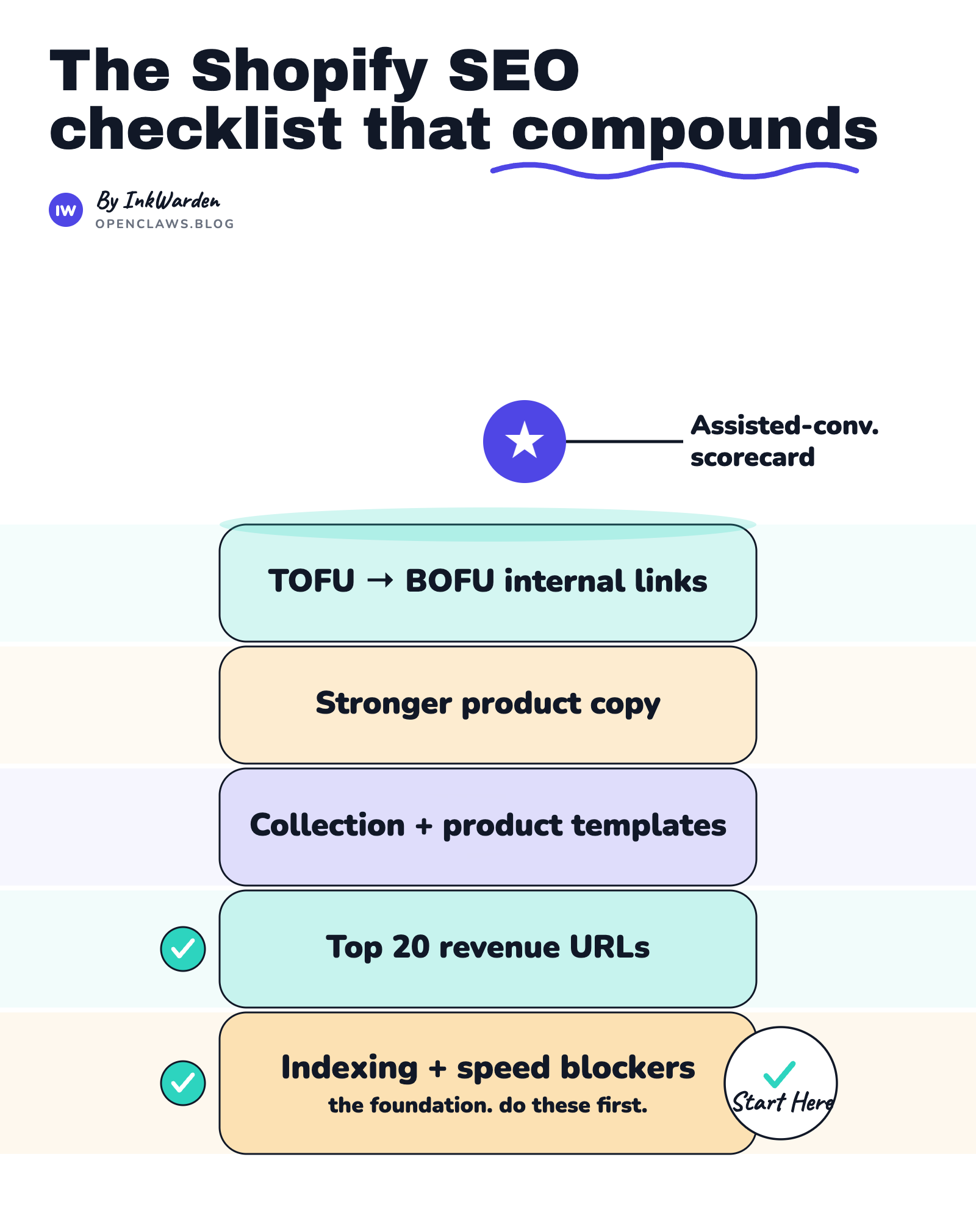
Foundation lane: core fixes that unblock growth
- Verify indexing status for top collection and product URLs in Search Console.
- Fix duplicate titles and thin meta descriptions on top revenue templates.
- Compress oversized images and tighten mobile layout to improve user speed signals.[6]
- Fix duplicate-page URL rules so search engines know which page version to rank between filtered collections and core category pages.[8]
- Clean redirect chains on retired products and seasonal pages.
- Add descriptive alt text on high-traffic product images.
- Standardize product template headings so each page has one clear H1.
- Check crawl blocks and noindex tags on any page expected to rank.
Imagine a merch manager auditing 20 revenue URLs in one afternoon. If 7 are non-indexed or near-duplicates, fixing those 7 usually beats writing 3 new blog posts this week.
Growth lane: growth fixes that build compounding traffic
- Map one clear intent per priority collection page, then rewrite intros to match search language.[4]
- Expand product copy where pages rely only on manufacturer text.
- Add comparison blocks and use-case snippets on top product pages.
- Create supporting TOFU guides around recurring buyer questions.[2]
- Link each TOFU guide to 2 to 3 relevant collection or product URLs.
- Build related-collection links on collection pages with clear anchor text.
- Refresh top pages every 45 days with new FAQs and buying context.
- Consolidate overlapping blog posts into stronger canonical guides.
- Track assisted conversions from organic landing pages, not only last click.
Here is the thing: your on-page seo checklist for shopify stores only compounds when informational and commercial pages support each other. If they live in separate silos, growth stays fragile.
If you need a repeatable weekly system, use this on-page SEO workflow as your operating rhythm.
8 fixes
Top revenue URLs first
9 fixes
Assisted conversion tracking
Comparison: Ecommerce SEO Checklist Shopify Teams Use vs Compounding Checklist
| Dimension | Generic Checklist | Compounding Checklist |
|---|---|---|
| Success metric | Tasks completed | Owned traffic growth and assisted revenue |
| Page priority | Blog-first, mixed order | Collection and product templates first |
| Technical work | Scattered hygiene tasks | Indexing and speed blockers first |
| Content links | Few paths to money pages | Planned TOFU to BOFU internal links |
| Weekly implementation hours (example sprint) | 6 to 8 hours spread across mixed low-priority tasks | 6 to 8 hours focused on top 20 revenue URLs first |
| Review cadence | Monthly or ad hoc | Weekly scorecard plus 30-day assisted conversion check |
A small brand team can run a generic seo checklist shopify sweep for 30 days and still miss revenue pages. Worth knowing: the compounding version forces tradeoffs. I think that is exactly why it works under budget pressure. Teams should stop treating low-intent tasks as equal to revenue-page fixes.
Getting Started This Week
- Baseline paid versus organic mix. Pull the last 90 days and write down sessions, revenue, and assisted conversions by channel.
- Audit your top 20 revenue URLs. Check indexing, speed, and duplicate template issues first.[6]
- Fix blockers before adding new content. In my experience, one indexation issue fixed on a top collection can beat weeks of low-priority writing.
- Rebuild three collection pages around buyer intent. Use plain language buyers type, then improve product adjacency links.[7]
- Create the internal-link bridge. Link two TOFU guides to five commercial URLs and track assisted conversions over 30 days.
In plain English: start with revenue pages. Picture a team lead blocking 4 hours on Monday and 4 hours on Thursday for one week. That 8-hour sprint can finish a shopify technical seo checklist baseline and launch your first compounding page cluster. Skip net-new blog drafts until blockers are cleared.
For deeper technical cleanup patterns, this technical SEO checklist is a strong companion.
Running this manually each week is the bottleneck. Inkwarden ships a fully audited post every week, from $50/mo. See how Inkwarden ships a fully audited post every week →
Weekly Tools and KPI Scorecard
If your team asks which tools to use for a shopify seo checklist each week, keep it simple by job. Put differently, one consistent stack run weekly beats five tools used randomly. Use one keyword platform only. Do not skip the weekly review slot.
- Indexation and crawl checks: Google Search Console.
- Template and on-page audits: your Shopify theme editor plus a crawler of choice.
- Query and ranking direction: one keyword platform (such as Ahrefs or Semrush), used consistently.
- Revenue attribution: your analytics tools, with assisted conversion views enabled.
Use one weekly scorecard and review it at the same time each week:
| Metric | What to log weekly |
|---|---|
| Indexed priority URLs | Count indexed out of your top 20 revenue URLs |
| Non-brand organic clicks | Week-over-week click trend from non-brand queries |
| Revenue-page CTR | Search CTR on key collection and product templates |
| Assisted conversions | Conversions where organic pages assisted the journey |
| High-impact fixes completed this week | Number of high-impact technical or content fixes completed |
FAQ
Is this Shopify SEO checklist PDF style approach better than a big master list?
Worth knowing: yes, for lean teams it is better. A giant list can be useful for completeness, but it hides tradeoffs. A prioritized sequence shows what moves traffic and revenue first. If you still want a shopify seo checklist pdf, keep one as a reference library, then run weekly execution from an impact-ranked sprint sheet. A simple artifact that works: one shared weekly tracking sheet with five columns (indexed priority URLs, non-brand clicks, revenue-page CTR, assisted conversions, and fixes shipped).
How many fixes should we run at one time?
Run fewer than you think. Start with a small set of foundation fixes on high-intent pages, then add growth fixes after blockers clear. Running 25 parallel tasks in two weeks is a mistake for most teams.
Should beginners focus on blog content or collection pages first?
If revenue pressure is real, start with collection and product templates first. Blog content matters, but only when it links clearly into commercial pages. A shopify ecommerce seo checklist should treat content and commerce as one path, not separate projects.
How long before we see results?
You can often see early movement in indexing and engagement signals after technical blockers are fixed. Meaningful owned-channel compounding usually needs a steady execution window. The key is consistent page quality updates and link paths into buyer pages.
Conclusion
Here is the thing: a useful shopify seo checklist is not a bigger list. It is a tighter sequence tied to revenue-page quality, internal links, and weekly measurement. Stop treating all checklist items as equal. Start with the highest-intent templates, finish a small set of fixes, and review your scorecard every week.
References
- Shopify: SEO Checklist (50 tips)
- Shopify: SEO Guide for Ecommerce Traffic
- Semrush: Ecommerce SEO Checklist
- Ahrefs: Ecommerce SEO guide
- BigCommerce: Ecommerce SEO checklist quick audit
- Google Search Central: Core Web Vitals
- Practical Ecommerce: SEO category resources
- BigCommerce: Technical SEO for ecommerce

Content marketer at InkWarden
Rachel writes about SEO, AEO, and Claude skill files for small teams and solo operators building durable organic growth.
View author profile →